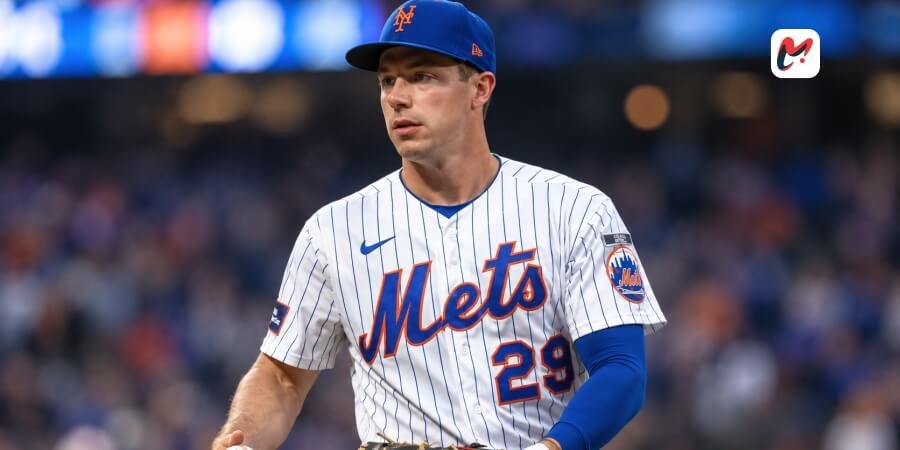
Baseball careers are not always lived out according to expectations. Jared Young was entering the 2026 season as a player trying to make a name for himself after limited opportunities in the majors and playing abroad. By September, Jared had already become one of the more valuable pieces of the New York Mets lineup as he was getting regular playing time at first base and contributing enough offensively to mean something in their plans.
The timing in Jared’s case made his rise noteworthy. The Mets didn’t go into the season thinking that Jared Young would be their everyday first baseman at all. He was actually seen more as an option to bring flexibility to the roster, as a player who could fulfil the role of a first baseman and an outfielder and be a left-handed bat.
A Long Route to New York
Jared Young’s path to the Mets was not built around immediate major-league success. The Chicago Cubs selected him in the 15th round of the 2017 MLB Draft, and it took five years for him to reach the majors. His early opportunities with Chicago were limited, which meant that his development largely happened outside the spotlight of a major-league roster.
That background helps explain why his 2026 emergence carries some significance. After spending time in the Korean Baseball Organization following the 2024 season, Young joined the Mets organization and eventually made the Opening Day roster. The move was not initially treated as the arrival of a major offensive piece. Instead, his ability to cover multiple positions gave New York a practical roster solution.
The Mets quickly discovered that there was more to the package than flexibility.
Versatility Opened the Door
Early in the season, Jared Young was used at first base and left field, particularly when the Mets faced right-handed pitching and Juan Soto was unavailable. That type of role can be valuable on a roster because it allows a manager to adjust the lineup without sacrificing a left-handed offensive option.
Young’s early production made the arrangement even more useful. On April 5 in San Francisco, he went 3-for-3 while making two strong defensive plays. But his promising start was interrupted when he suffered a torn meniscus in his left knee. The injury required surgery and was initially expected to keep him out for six to eight weeks.
An injury that could have ended his momentum instead became a test of whether he could regain the form that had earned him the roster spot in the first place.
The Return Changed His Role
In June, it was reported by MLB that the Mets had seen the return of a more productive Jared Young. Since Young’s return to the Mets’ roster, his OPS stood at .756 with six home runs in 26 games, which led the interim manager Andy Green to grant him the bulk of first base plays. This was quite remarkable, especially since the team had six different starters at the first base position that season. Therefore, Young was more than just a body filling the first base position, but yet a reliable source of offense.
In particular, Young made some outstanding defensive plays. In the game against Philadelphia in June, Young brought in the only run for the Mets by hitting against Zack Wheeler and performed some good defensive plays, including a double play that he completed on his own.
A Bigger Offensive Contribution
By the end of August, Jared Young was not simply a utility player anymore. According to MLB, he leads the Mets in OPS with .770 at that time, although at the beginning of the season, his inclusion in the roster was perceived as a surprise. It was interesting to observe Young’s achievements in his first complete season in MLB.
Seasonal stats prove the same. According to MLB current data, Young has hitting .268, with nine home runs, 38 RBIs, and .763 OPS after 299 at-bats. The information from Baseball-Reference shows numbers like .268 batting average, .332 OBP, and .431 SLG, and gives 2023 stats the OPS+ of 113.
These stats do not imply that Jared has turned into a superstar player. It shows that Young became a valuable offensive player when playing in a position that required the Mets to receive stability.
A Season That Changed the Conversation
On September 17, an unfortunate incident took place that would change Jared Young’s fortunes for the season because he was hit by a dead-on collision with teammate Nolan McLean and ended up with a head injury while playing first base against the team from Philadelphia. Jared was taken out of the game on a stretcher, after having spent quite some time on the field. It was later confirmed by the Mets that Jared was conscious and able to feel his extremities, which was great news given the nature of the injury. However, Jared did show symptoms of a concussion and it was during the latest reports that he was at the hospital for further checks.
The above-mentioned incident affected brilliantly an outstanding season that Jared had before the injury. To illustrate: according to Reuters, Jared had played 103 games by that time, earning an average of .266 with nine home runs and 39 RBIs.
In other words, 2026 becomes the season full of meaning rather than statistics. He is the player who took advantage of mobility and gambled all of it winning thus the trust of the Mets and his opportunity to play as a regular first baseman. Whatever comes next, that transformation has already made his 2026 season one of the more revealing individual stories in the Mets’ campaign.