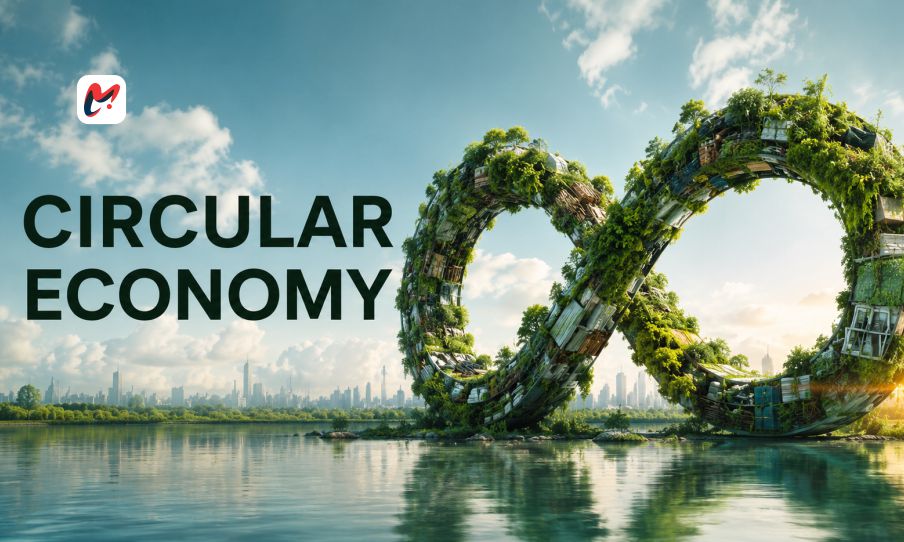
The concept of a ccircular economy is gaining increasing attention in modern society. Traditional approaches to economic development are no longer appropriate, and more companies and governments are eager to find a more effective solution. The main problem that companies need to solve before implementing these changes is determining what is a circular economy and how to use its principles in practice. This alternative approach to industrialization can help make the planet a better place.
Modern Principles of Circular Economy
For more than a century, the entire world economy has followed the same path of development that is now considered completely inappropriate. To find an answer to the question, “What is a circular economy?” and move from the current state to a desirable one, it is necessary to change significantly and complicate the work of most businesses. In particular, they should focus on reprocessing materials and returning them to the production cycle. In this way, the entire system would work to ensure that nothing goes to waste. Of course, the volume of industrial activity will not decrease, but its accompanying waste will be minimized.
At the same time, the modern principles of a circular economy can allow businesses to maintain their profits for as long as possible. As an answer to the question, “What is a circular economy example?” indicates, this concept implies the ability to isolate materials from the production cycle for as long as possible. This will create a barrier to the already acute global shortage of natural materials and prevent the prices of companies’ assets from fluctuating unpredictably. After all, the amount of waste generated by a company will be much lower, and the money spent on producing and processing raw materials will be significantly reduced. Any company that wants to ensure long-term survival and preserve natural resources should consider this issue very carefully.
Redesigning Production Cycles to Eliminate Resource Depletion
The true magic of this transition happens at the drawing board, long before a product ever reaches a consumer’s hands. To truly grasp what is circular economy systems, one must look closely at product design, where choices are made to maximize durability, modularity, and easy disassembly. In a ccircular economy, a smartphone or an appliance is no longer viewed as a disposable item meant to be replaced every two years. Instead, items are intentionally engineered so that individual components can be easily swapped out, upgraded, or recycled back into the production pipeline without losing their inherent material quality.
This intentional design philosophy forces manufacturers to take full responsibility for the entire lifecycle of their creations. When analyzing what is circular economy business models, we frequently see a rise in service-oriented setups, where customers lease products rather than buying them outright. In this version of a ccircular economy, the manufacturer retains ownership of the physical goods and has a direct financial incentive to make them last as long as possible. When a product finally reaches the end of its functional life, the company takes it back, harvesting the precious components to build the next generation of goods.
Cultivating Collective Action Across Modern Global Networks
Transitioning on a massive scale cannot happen through isolated corporate initiatives; it requires deep collaboration across entire supply chains. Fully realizing what is circular economy benefits demands that governments, local communities, and global corporations actively synchronize their efforts. A thriving ccircular economy relies heavily on robust regional infrastructure, standardized material tagging, and progressive public policy that rewards sustainable innovation. When these distinct pieces align, entirely new industries emerge to bridge the historical gap between consumption and reclamation.
Consumers also play an essential role in keeping this system moving forward through their daily purchasing decisions and disposal habits. Cultivating an awareness of what is circular economy values encourages individuals to prioritize pre-owned goods, support repair businesses, and participate in local collection programs. By demanding transparency and circularity from favorite brands, everyday citizens help accelerate the growth of a global ccircular economy. This collective commitment transforms the marketplace from a one-way street of consumption into a vibrant, self-sustaining loop where everyone benefits.