
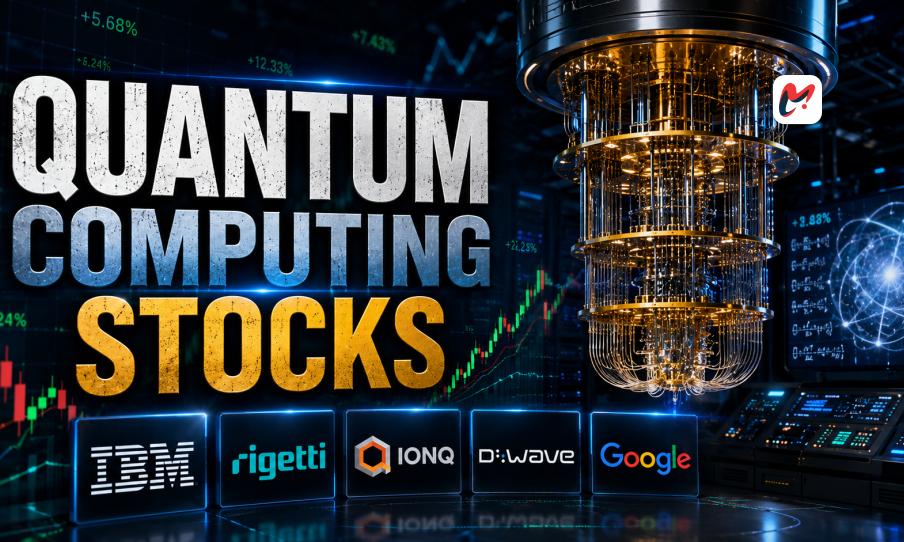
A quiet change rolls through money markets when tools built for science labs start turning up in boardrooms. Once seen as risky bets with no clear payoff, shares tied to quantum computing stocks now move fast among traders. Sudden jumps come not just from new code but also big spending by nations and rising profits in firms. People who thought such ideas belonged only in textbooks suddenly reshuffle their holdings, chasing gains that might reshape how tech evolves. The ground shifts under old assumptions – what felt like fantasy inches closer each day. Interest around quantum computing stocks keeps rising as institutions search for the next major technology breakthrough.
The Sudden Jump In Markets What Set It Off
Years passed while quantum computers struggled to grow larger and keep mistakes low. Qubits – those odd building blocks – tend to wobble out of control unless locked inside frigid, shielded chambers. Then came a shift: Nvidia stepped forward with “Ising,” a set of openly shared A.I. tools built for tuning quantum chips. These programs fix glitches faster than before by streamlining how corrections happen across circuits. Stability in number crunching took an upward turn because of it. Analysts tracking quantum computing stocks immediately noticed how software innovation started influencing market momentum.
Right away, investors responded strongly to the new software linkup. Stocks of dedicated quantum firms jumped sharply during one day’s trading, showing confidence in quicker profits. Instead of waiting years, some experts now think real-world use could happen sooner. Progress fueled by code advances reveals machines are ready for practical tasks earlier than expected. What once seemed like lab work only is now stepping into everyday operations. Momentum surrounding quantum computing stocks strengthened as traders anticipated broader commercial adoption.
Government Support Solidifies the Industry Balance Sheet
If software breakthrough was the initial spark, government intervention has provided the financial foundation. The United States Department of Commerce recently announced a historic two-billion-dollar direct equity investment distributed across leading quantum computing firms. This represents a significant shift from traditional research grants, as the federal government is effectively becoming a co-investor and shareholder in the sector to secure technological leadership and protect national security infrastructure. Such developments continue drawing fresh attention toward quantum computing stocks from institutional investors.
The distribution of these funds has completely changed the financial safety net for several public companies. IBM received a massive one-billion-dollar allocation to establish a dedicated quantum chip manufacturing facility in New Albany, New York, called Anderon. Meanwhile, smaller pure-play pioneers like D-Wave Quantum and Rigetti Computing secured roughly one hundred million dollars each to address hardware scaling and cooling challenges. When a government takes direct equity stakes in an emerging industry, it drastically lowers the risk profile for private venture capital and retail investors, providing these volatile stocks with unprecedented long-term balance sheet stability. Confidence in quantum computing stocks has increased because of this federal backing.
Understanding the Landscape of Pure Plays and Mega Cap Giants
Investors looking for exposure to this space generally choose between two distinct strategies: high-risk pure plays or diversified technology giants. Pure-play stocks like IonQ lead the commercial revenue race, recently reporting record quarterly revenues of over sixty-four million dollars driven by cloud partnerships with Amazon Web Services, Microsoft Azure, and Google Cloud. IonQ utilizes a unique trapped-ion technology that manipulates individual atoms with lasers, avoiding some of the extreme cooling requirements that challenge its competitors. These developments continue positioning quantum computing stocks as high-growth opportunities for aggressive investors.
On the other side of the spectrum are the established tech giants that provide a safer route into the quantum era. Companies like IBM, Alphabet, and Microsoft are investing billions into their own proprietary quantum architectures while maintaining highly profitable legacy businesses in cloud computing and enterprise software. Additionally, semiconductor leaders like Nvidia and Taiwan Semiconductor Manufacturing Company act as essential infrastructure providers, designing the advanced graphics processing units and hybrid circuits necessary to control quantum systems. While the pure plays offer explosive upside potential, the mega-caps provide a sturdy buffer against the inherent volatility of a developing tech sector. Long-term investors continue monitoring quantum computing stocks for signs of sustainable profitability.
Managing Volatility and Cyber Security Risks in the Quantum Age
Despite the recent financial success and government backing, investing in this sector requires careful risk management. Many pure-play firms continue to operate with significant net losses as they scale up manufacturing and research operations. Stock prices can experience massive swings based on trial results, contract announcements, or policy shifts. Furthermore, the industry is closely tied to the urgent world of post-quantum cryptography, as the rising power of quantum systems creates a real threat to modern encryption standards, including global blockchain networks and financial software. These uncertainties make quantum computing stocks both exciting and highly unpredictable.
To successfully navigate this market, diversification is key. Rather than trying to pick a single winning hardware architecture, many investors utilize specialized exchange-traded funds like the Defiance Quantum ETF to spread risk across hardware developers, software designers, and cybersecurity firms specializing in quantum-resistant infrastructure. Treating quantum investments as a long-term marathon rather than a short-term sprint allows investors to participate in the massive upside of this computing revolution while protecting their capital from the inevitable bumps along the way. As innovation accelerates further, quantum computing stocks may remain one of the most closely watched sectors in modern technology investing.
Read Also : Crafting the Perfect Angle: Navigating the Nuances of Media Pitch vs Press Release