
For centuries, travelers, nature lovers, and scholars have been puzzled by the biological differences between buffalo and bison. Despite being often interchanged in colloquial speech, popular culture, and literature, these two majestic creatures differ significantly in terms of taxonomy, appearance, and distribution. Close examination of the bison and buffalo differences and similarities allows not only to distinguish between these large mammals but also to admire the variety of wildlife and understand the details of evolution. Ultimately, recognizing buffalo vs bison is important to separate the myths from the reality and resolve the century-old confusion perpetuated around these animals.
Buffalo vs Bison: Differences in Anatomy and Appearance
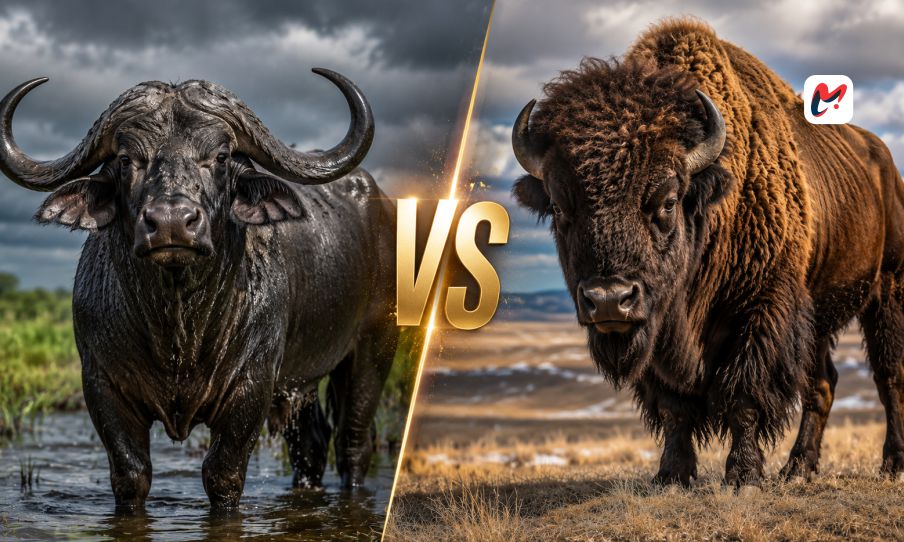
Several major features allow distinguishing between buffalo and bison on first sight. For instance, while examining the head area, one can notice that American bison have a distinct hump on their shoulders, which is absent in buffalo. The heavy build of the bison shoulder enables the animal to use its strong neck muscles to push the ground and clear the snow off the grass in winter. In turn, buffalo lack this adaptation, characteristic of bison. Furthermore, while investigating the buffalo vs bison differences in anatomy, one should pay attention to their horns. The two species differ in horn shape, size, and direction. The Cape buffalo, for example, has massive, sprawling horns, which are connected at the base, forming a boss, while the water buffalo has large crescent-shaped horns, curving backward. In turn, bison have relatively short, simple, and narrow horns, which are directed vertically. Apart from the horns and head shape, bison have a thick coat and a shaggy chin beard, which are absent in their buffalo counterparts. Such adaptations allow bison to survive the severe North American winters, which are not typical for the tropical climate of buffalo habitats.
Exploring Geographic Habitats and Evolutionary Backgrounds
The geographical origins of these broad-chested grazers further highlight why the comparison of buffalo vs bison is such an essential topic for wildlife enthusiasts. Genuine buffalo are native strictly to the warm continents of Africa and Asia, where they have thrived in tropical, subtropical, and marshland environments for thousands of years. The water buffalo is deeply tied to river systems, swamps, and flooded plains across South and Southeast Asia, whereas the Cape buffalo roams savanna woodlands, grasslands, and dense brush across central and southern Africa. Conversely, the term bison properly refers to two living species native to northern climates: the American bison and the European bison, also known as the wisent. The widespread dynamic of buffalo vs bison confusion largely originated when early European settlers arrived in North America and mistakenly referred to the sprawling herds of American bison as buffalo, likely because the unfamiliar animals vaguely resembled the Old World livestock with which they were already familiar. Over time, that misnomer took deep root in American literature, western songs, and popular idioms. However, scientifically speaking, true buffalo have never been indigenous to North America, making the geographic boundary between the species completely distinct.
Cultural Significance and Ecological Role in the Wild
Beyond physical traits and geographic roots, the ecological impact and cultural importance surrounding buffalo vs bison reveal how deeply both animals are woven into human history and natural ecosystems. In North America, the bison served as a crucial keystone species on the vast Great Plains, shaping grasslands through grazing patterns, wallowing behaviors, and seed dispersal mechanisms. Indigenous tribes maintained a sacred relationship with the animal, utilizing every portion of its body for food, shelter, clothing, tools, and spiritual practices. Exploring the narrative of buffalo vs bison underscores how human activity brought the American bison to the brink of total extinction in the nineteenth century through intense overhunting, followed by one of the most remarkable conservation turnarounds in modern history. Meanwhile, in Asia, the domesticated water buffalo transformed human civilization as a vital draft animal for rice farming and rural agriculture, earning a reputation as the living tractor of the East. In Africa, the unpredictable Cape buffalo earned immense respect as one of the most dangerous, untamed game species on the continent, playing a vital role in keeping savanna landscapes balanced through heavy grazing.
In conclusion, taking the time to explore the facts behind buffalo vs bison helps replace widespread confusion with genuine appreciation for these magnificent creatures. Although popular tradition will likely continue calling the American bison a buffalo in folksongs and local legends, knowing the underlying scientific differences enhances our understanding of the natural world. Whether observing a broad-horned water buffalo wading through a wetland or watching a shaggy bison herd thunder across wide prairie fields, each animal stands as a testament to nature’s remarkable diversity and resilience.