
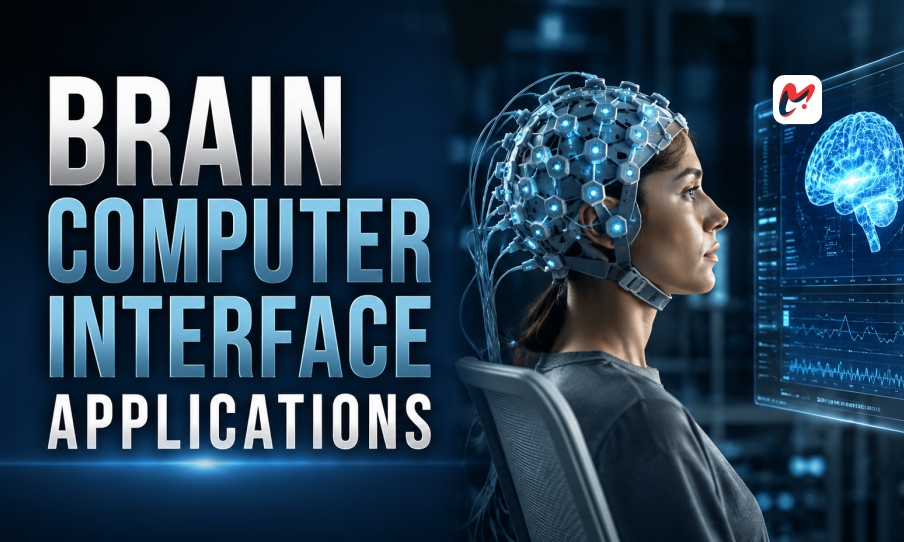
In recent decades, the development of ways for people to communicate with machines has become very rapid. From keyboards and touchscreens to voice assistants, technology becomes more accessible to people. Scientists are currently working on a revolutionary invention; the opportunity for a person to communicate with a computer through brain activity. This technology will be able to fundamentally change healthcare, communications, education, defense, and entertainment.
The increasing need for brain computer interface (BCI) applications is dictated by the current and future capabilities of neuroscience, and the possibilities opened up by artificial intelligence and machine learning. Information from the brain in the form of electrical impulses is received and decoded with special algorithms. BCI will allow you to create communication channels with a computer in the future that would significantly differ from the existing ones.
The work of the brain computer interface is based on several key principles. First, some of the basic knowledge from neuroscience will be used, namely the features of brain activity. To read thoughts, scientists use special algorithms that decode electrical impulses transmitted from one neuron to another. Second, BCI implies interaction with external devices: a computer or other machines. Information about the activity of the brain can be used, for example, for control over various technical devices such as computers, robotic arms, wheelchairs, and many others. Brain computer interface applications can be used both invasively and non-invasively. The first method involves using implanted electrodes, while the second method uses non-invasive tools, such as EEG. The invasive method is more accurate, but the non-invasive method is safe and convenient for a person.
Artificial intelligence has played a crucial role in improving the precision of signal interpretation. Machine learning models continuously learn from brain activity, making these interfaces more responsive and reliable over time. This combination of neuroscience and AI is accelerating the commercialization of BCI technologies across multiple industries.
Healthcare Leads the Adoption of Brain-Computer Interface Technology
Healthcare remains the most promising field for brain computer interface applications. For individuals living with paralysis, spinal cord injuries, or neurodegenerative diseases, BCIs offer a new method of communication and independence. Patients who are unable to speak can generate text or control digital devices simply by thinking about specific actions.
Researchers have also developed robotic prosthetic limbs that respond directly to brain signals, allowing amputees to perform everyday activities with greater precision. Rehabilitation centers are increasingly experimenting with BCIs to help stroke patients regain motor function by encouraging neural rewiring during therapy sessions.
Mental health research is another emerging area. Scientists are studying how brain activity can be monitored to better understand disorders such as depression, anxiety, and epilepsy. Although many of these developments are still in clinical trials, they highlight the enormous potential of the technology to improve patient care and quality of life.
Expanding Opportunities Across Industries
Beyond medicine, brain computer interface applications are finding relevance in several commercial sectors. The gaming industry is experimenting with headsets that allow players to control characters through concentration and cognitive commands, creating more immersive experiences than traditional controllers.
In education, adaptive learning platforms may eventually monitor student engagement levels and modify lessons according to attention patterns. Such systems could personalize education while helping teachers identify when learners struggle with difficult concepts.
Industrial environments may also benefit from BCI technology. Operators working in high-risk settings could use hands-free controls for machinery, while cognitive monitoring systems might detect fatigue before accidents occur. Similarly, defense organizations continue to explore brain-controlled systems for enhanced situational awareness and communication in complex environments.
Consumer electronics companies are investing heavily in wearable brain-sensing devices. As these products become smaller and more affordable, everyday users may eventually interact with smart homes, augmented reality devices, or personal assistants using neural commands instead of physical inputs.
Challenges That Will Shape the Future
Despite remarkable progress, several obstacles must be addressed before BCIs become mainstream. One of the biggest concerns involves privacy. Since brain signals may reveal sensitive cognitive information, protecting neural data from misuse will require strict cybersecurity measures and comprehensive legal frameworks.
Accuracy also remains a challenge. Brain signals are complex and vary significantly between individuals. Environmental noise, movement, and emotional states can affect signal quality, making consistent performance difficult outside laboratory conditions.
Ethical considerations are equally important. Questions surrounding informed consent, cognitive enhancement, and ownership of neural data continue to generate debate among scientists, policymakers, and technology companies. Establishing clear regulations will be essential to ensure responsible development.
Cost presents another barrier. Advanced implanted systems require specialized surgical procedures and extensive medical supervision, limiting accessibility for many patients. Continued research and technological improvements are expected to reduce these costs over time, making BCI solutions more widely available.
The future of brain computer interface applications will depend not only on scientific breakthroughs but also on public trust. Transparent development practices, rigorous clinical testing, and thoughtful regulation will determine how quickly society embraces these innovations.
Looking Ahead
Brain-computer interfaces represent one of the most exciting frontiers in modern technology. By enabling direct communication between the brain and machines, they have the potential to transform healthcare, improve accessibility, enhance productivity, and create entirely new forms of digital interaction.
As artificial intelligence, neuroscience, and computing continue to advance together, the capabilities of these systems will expand beyond today’s expectations. While technical, ethical, and regulatory challenges remain, the pace of innovation suggests that brain-computer interfaces will become an increasingly important part of our technological landscape. The coming years may witness a shift where interacting with devices through thought becomes as natural as using a keyboard or speaking to a virtual assistant, opening possibilities that were once limited to imagination.