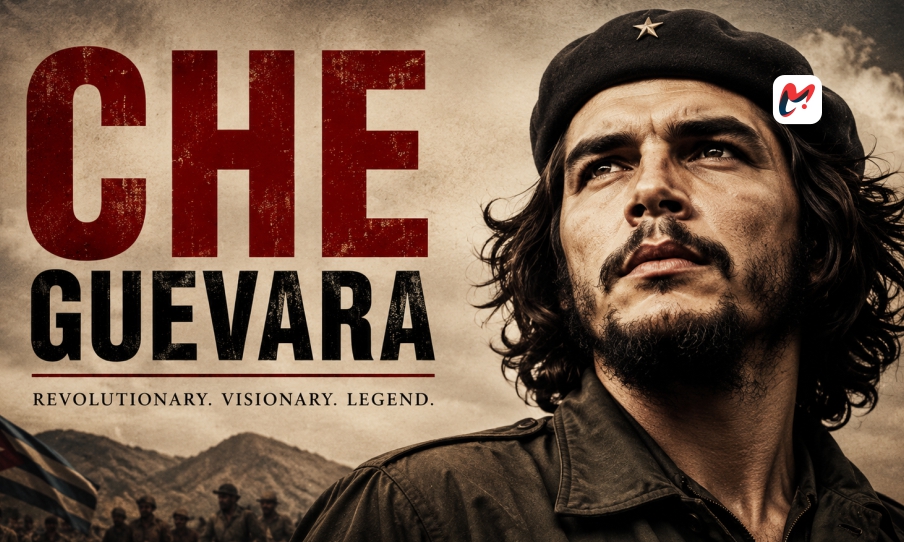
Few figures in history have generated such mixed opinions as Che Guevara. His image has become iconic around the world, and it is challenging to find a person who would not recognize the mustachioed face of this Cuban revolutionary. Yet, the real history of the man behind the icon is closely linked with the events of the 20th century. People perceive Guevara differently: while some consider him the symbol of the fight against imperialism, others view his actions as the most vicious form of fascism. In this regard, it is essential to take a closer look at the man and the environment that shaped his ideology.
The Man behind the Icon
Che was born in Rosario, Argentina, in 1928. The future revolutionary came from a relatively well-off family of doctors and engineers who had a rich library of philosophical books at home. His father took care of arranging his medical studies at the University of Buenos Aires, where Guevara officially enrolled. However, the young Guevara was more interested in studying philosophy than medicine. His lifelong passion for reading and writing remained the same, and he started contributing articles to national magazines.
The events that occurred during his journey through South America changed his future forever. Seeing the poverty and lack of basic life conditions forced the revolutionary to think about the causes of these problems. It was the realization that the system was the root of the issue and that only a political revolution could resolve it.
His travels also introduced him to activists and political movements that questioned foreign influence and authoritarian governments in Latin America. The combination of personal experiences and ideological exposure laid the foundation for the revolutionary path he would soon follow.
The Cuban Revolution and Political Influence
The life of Che Guevara changed dramatically after meeting Fidel Castro in Mexico during the mid-1950s. Sharing similar political goals, the two joined forces to overthrow the Cuban government led by Fulgencio Batista. Guevara served as both a military commander and strategist during the guerrilla campaign, earning a reputation for discipline, determination, and commitment to the revolutionary cause.
Following the success of the Cuban Revolution in 1959, he assumed several important government positions. He played a role in economic planning, industrial development, and diplomatic relations while representing Cuba on international platforms. His speeches frequently criticized colonialism, imperialism, and economic exploitation, making him a prominent voice during the Cold War.
However, his period in government remains one of the most debated aspects of his legacy. Supporters credit him with advocating education, healthcare, and national sovereignty, while critics highlight his involvement in revolutionary tribunals and strict enforcement of political ideology. Historians continue to examine these events from multiple perspectives, emphasizing the importance of understanding them within their historical context rather than through simplified narratives.
International Revolutionary Campaigns and Lasting Legacy
Despite holding influential positions in Cuba, Guevara believed that revolutionary movements should spread beyond national borders. Motivated by this vision, he left Cuba to support armed struggles in other countries. His first major effort took place in the Congo, where political instability and logistical challenges ultimately led to failure.
Undeterred, he later traveled to Bolivia with the hope of inspiring another revolutionary movement. The campaign struggled from the beginning due to limited local support, difficult terrain, and increasing pressure from Bolivian forces backed by foreign intelligence. In October 1967, he was captured and executed, ending his life at the age of thirty-nine.
Ironically, his death transformed him into an enduring international symbol. Alberto Korda’s famous photograph became one of the most reproduced images in modern history, appearing in art, fashion, political campaigns, and popular culture. While many people recognize the portrait instantly, fewer understand the historical events behind it. This contrast between image and reality continues to fuel discussions among scholars, historians, and political commentators.
The influence of Che Guevara extends far beyond Latin America. His writings on guerrilla warfare and revolutionary strategy have been studied by political movements around the world. At the same time, his critics argue that romanticizing armed revolution overlooks the human costs associated with violent conflict. As a result, interpretations of his legacy often depend on political beliefs, historical context, and personal values.
Why His Story Continues to Matter
More than half a century after his death, debates surrounding Che Guevara remain remarkably relevant. His life raises enduring questions about inequality, political change, nationalism, and the ethics of revolutionary action. Was he an idealist willing to sacrifice everything for his beliefs, or did his commitment to ideology justify actions that should be critically examined? Historians continue to explore these questions through newly available documents, eyewitness accounts, and scholarly research.
His story also illustrates how historical figures can evolve into cultural icons whose meanings shift over time. Today, his image is worn by people with vastly different political opinions, sometimes without any knowledge of the individual behind the portrait. This phenomenon highlights the powerful relationship between history, media, and popular culture.
Rather than viewing him solely as either a hero or a villain, studying Che Guevara encourages a more balanced understanding of twentieth-century history. His life reflects the political tensions of the Cold War, the aspirations of revolutionary movements, and the ongoing struggle over how societies remember influential yet controversial individuals.
Ultimately, Che Guevara remains one of history’s most recognizable and disputed personalities. His influence survives not only through books and documentaries but also through continuing conversations about justice, revolution, leadership, and the responsibilities that come with pursuing political change. Whether admired, criticized, or simply studied, his legacy continues to shape discussions about power and resistance in the modern world.