
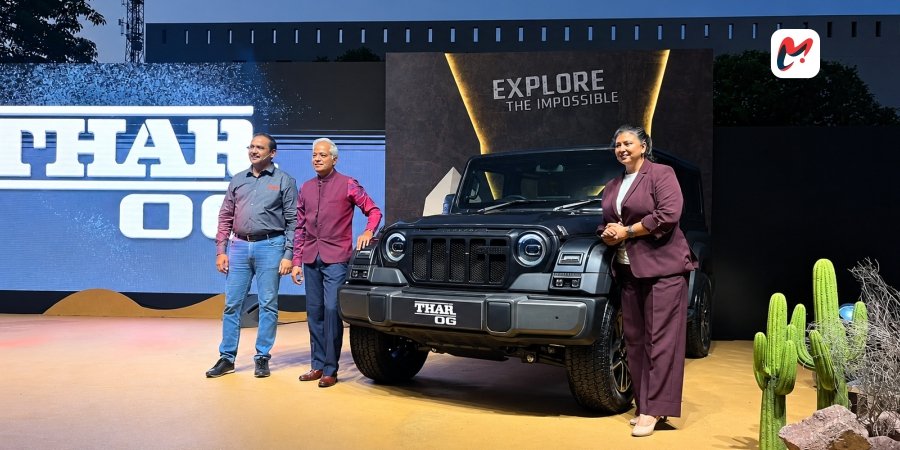
The Mahindra Thar has never needed much explanation. Its upright stance, short overhangs and unmistakable three-door profile have made it one of India’s most recognizable lifestyle SUVs. Yet the 2026 Thar OG is interesting for a different reason. It looks familiar at first glance, but Mahindra has made substantial changes underneath the body. This is not simply another cosmetic refresh. The company has revised the platform, suspension, steering, powertrain outputs, safety equipment and off-road hardware while keeping the character that made the three-door Thar popular.
Launched on September 22, 2026, the Thar OG starts at ₹10.32 lakh ex-showroom, with introductory pricing extending to November 30. Deliveries are scheduled to begin on October 11. The new model succeeds the three-door Thar introduced in 2020 and arrives after more than four lakh customers have joined the Thar community, according to Mahindra.
The Thar OG Is More Than a Facelift
The biggest story behind the Thar OG is the platform. Mahindra has moved the three-door SUV onto its M_Glyde 4G architecture, the same basic platform family used by the larger Thar Roxx. The company says the newer architecture offers greater structural stiffness, while the rear suspension now uses a PENTALINK arrangement with a Watts Link.
That change matters because the three-door Thar has always had to balance two very different personalities. It needs enough suspension articulation and ground clearance for trails, but owners also use it for everyday commuting. The new setup is intended to improve stability and control without turning the SUV into something fundamentally different. Mahindra has also introduced DAVINCI damping with frequency-dependent damping technology and electric power steering, targeting a more controlled ride and easier low-speed manoeuvring.
The dimensions have changed modestly as well. The Thar OG is 3,995mm long and 1,870mm wide, compared with 3,985mm and 1,820mm for the outgoing version. Its ground clearance rises to 232mm from 226mm, while the wheelbase remains 2,450mm. The wider body and track should give the SUV a more planted stance, although its approach angle drops slightly as part of the revised front-end design.
More Power From Familiar Engines
Mahindra has retained the three-engine strategy, but two of the powertrains gain additional output. The 2.0-litre mStallion turbo-petrol now produces 119kW and 330Nm, while the 2.2-litre mHawk diesel develops 111.9kW and 330Nm. The smaller 1.5-litre CRDe diesel continues with 87.2kW and 300Nm.
The changes make the Thar OG more interesting for buyers who want a three-door SUV that can perform beyond occasional off-road use. The petrol and larger diesel can be paired with automatic transmissions, while four-wheel drive remains available on the more powerful versions. The new electronic locking differential adds another layer of capability when traction becomes difficult.
Mahindra has also added dedicated Mud, Sand and Snow terrain modes. These systems do not replace mechanical off-road fundamentals, but they can help manage wheel slip and engine response when conditions change. For someone who occasionally leaves the pavement rather than spending every weekend on technical trails, that added electronic assistance could make the SUV easier to use.
The Familiar Face Gets a Modern Touch
Visually, Mahindra has been careful not to dilute the identity of the Thar OG. The basic boxy silhouette remains intact, but the front receives a redesigned grille, circular LED headlamps and C-shaped daytime running lights. The bumpers are also new, while LED fog lamps gain a cornering function.
The most obvious visual upgrade may be the new 19-inch alloy wheels on the ZXT variant. That is a notable change for a vehicle whose traditional appeal has always been more rugged than polished. Two new exterior colours, Artemis Silver and Jeans Blue, expand the palette alongside the existing shades. At the rear, redesigned LED tail lamps and a simpler bumper complete the refresh.
Inside, Mahindra has tried to make the three-door layout feel less utilitarian. The Thar OG gets truffle-brown leatherette upholstery, a softer second-row armrest with a cupholder, rear USB Type-C connectivity and additional cabin touches. The 10.25-inch infotainment screen carries over from the 2025 update rather than being an entirely new addition. Higher variants also receive wireless charging and additional convenience equipment.
Safety Has Taken a Bigger Role
Safety is another area where the Thar OG moves beyond the earlier three-door formula. Mahindra has added all-disc brakes, front parking sensors and an expanded electronic stability package. Six airbags are available on the top specification, including four head-pelvis-thorax-shoulder airbags designed to provide additional protection for occupants.
There is some variation across the range, however. Autocar India’s specifications indicate that the lower and mid-level versions do not receive the same six-airbag equipment as the flagship ZXT. That distinction is important for buyers comparing variants rather than simply looking at the model’s headline feature list.
Where the Thar OG Fits in the Thar Family
The introduction of the Thar OG also clarifies Mahindra’s broader Thar strategy. The three-door version remains the compact, more traditional interpretation of the nameplate, while the five-door Thar Roxx offers greater space and family practicality.
That creates an interesting balance. The Thar OG still has only four seats, and its compact three-door architecture remains less convenient for passengers and luggage than the Roxx. Its higher-specification variants can also approach ₹19 lakh ex-showroom, pushing it into a price bracket where buyers have plenty of alternatives. The starting price, however, remains unchanged from the outgoing model at ₹10.32 lakh for the introductory range.
What Has Really Changed?
The most meaningful changes to the Thar OG are not the new grille or larger wheels. They are the engineering revisions that are difficult to appreciate from a photograph. The M_Glyde 4G platform, revised rear suspension, DAVINCI damping, electric steering, additional engine output, electronic locking differential and expanded safety equipment collectively change how the SUV is intended to behave.
That makes the 2026 model an unusual update. Mahindra has preserved the visual formula that made the three-door Thar recognizable while changing much of the machinery underneath it. The result is still unmistakably a Thar, but it is being asked to do more than the original modern-generation model did.
Finally, the Thar OG represents Mahindra’s attempt to keep an enthusiast-oriented SUV relevant without turning it into something ordinary. The boxy shape, three-door layout and off-road focus remain intact, while the engineering underneath moves closer to the expectations of a modern daily driver. For existing Thar fans, that may be the most important change of all: Mahindra has updated the machine without erasing the character that made people want one in the first place.