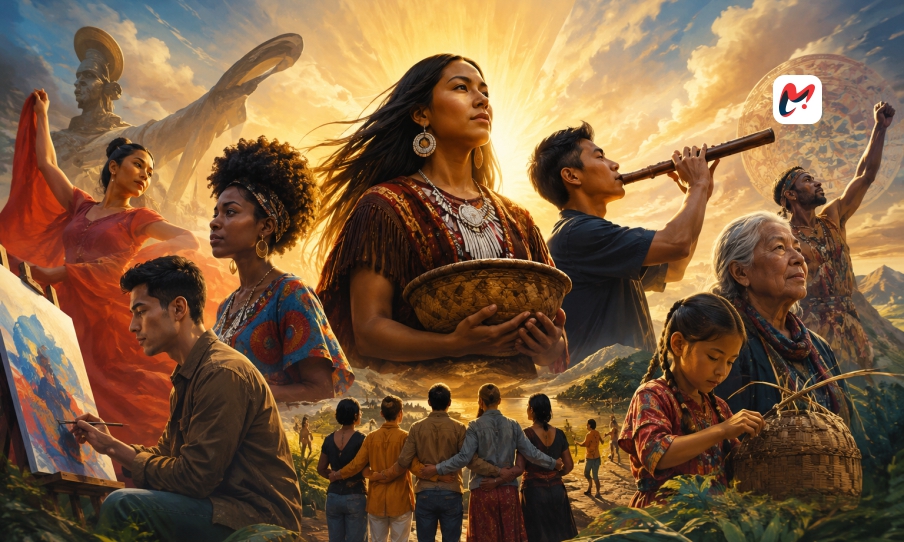
Old ways, speech, words handed down – these shape how people live together. Still, far too often, outside forces crowd them out. One person speaking up can change what happens next. Not always loud. Sometimes just showing others they matter does enough. Tools appear where none existed before. Spaces open without asking permission. Confidence builds because someone says it is right to remember. Pride spreads slowly at first – then faster. Work changes when meaning returns. Decisions once made elsewhere now happen close to home. What was dismissed as outdated becomes useful again. Progress looks different when everyone gets to define it.
Something shifts when people start seeing culture not as fixed stone but as something growing, needing care to stay alive amid constant change. Behind every step forward there are individuals quietly breaking down walls inside minds – the kind that make someone feel wrong for honoring where they came from. Respecting the past does not mean freezing it; instead, space opens up for new voices to speak old truths in fresh forms. Moving through today’s tangled sense of self can be overwhelming – especially for those pushed to the edges – and yet guidance appears in the form of steady hands pointing toward belonging. Progress feels different when variety isn’t added on at the end like an afterthought but stands right at the center, shaping everything else.
The Ways People Rebuild Who They Are and Their Communities After Hard Times
Right where change begins, groups find strength in naming who they are. Not only do cultural sparks open doors, but they also place old wisdom beside school-taught ideas without ranking one higher. Reviving a fading tongue might happen alongside saving native farming ways – each act quietly stitching bonds among neighbors. Seen in government halls or marketplaces, familiar traditions boost belief in personal power. From that quiet rise comes deeper involvement in public life, along with firmer steps toward fairness when facing deep-rooted gaps.
Furthermore, the impact of these movements extends far beyond the preservation of artifacts or rituals. By positioning themselves as cultural empowerment catalysts, leaders can foster a sense of psychological safety that is essential for innovation. When individuals feel secure in their identity, they are more likely to take risks and contribute unique perspectives to global problem-solving. This resilience is particularly crucial in an era where cultural homogenization threatens to erase the nuances of the human experience. By championing the specific over the generic, we protect the cognitive diversity that is necessary for solving the complex challenges of the twenty-first century.
Navigating the Intersection of Tradition and Modern Innovation
A common misconception is that focusing on heritage implies a rejection of modernity; however, the most effective cultural empowerment catalysts prove that the opposite is true. They demonstrate how traditional wisdom can be synthesized with modern technology to create something entirely new and profoundly impactful. For instance, digital archives and social media platforms are being used to give global visibility to ancient art forms, while traditional ethical frameworks are being applied to modern corporate governance. This synthesis ensures that the community does not become a museum piece, frozen in time, but remains a dynamic contributor to the global economy.
The economic dimension of this work cannot be overstated, as financial independence is often a prerequisite for true self-determination. Cultural empowerment catalysts often work to develop sustainable business models that respect local customs while accessing international markets. By ensuring that the intellectual property of a community is protected and that the benefits of their heritage stay within the group, these advocates prevent the exploitative “commodification” of culture. Instead, they promote a model of “cultural capital” where the community’s unique attributes become the engine of their own prosperity. This approach turns the tide against historical patterns of extraction and replaces them with a cycle of reinvestment and growth.
The Global Ripple Effect of Localized Cultural Agency
While the primary focus of these efforts is often local, the global implications are profound. As more groups find their footing through the work of cultural empowerment catalysts, the global dialogue becomes richer and more representative. This shifts the international power balance away from a monolithic viewpoint toward a multipolar exchange of ideas. In a world increasingly prone to division, the celebration of distinct identities—when framed through the lens of mutual respect—actually fosters a deeper sense of global citizenship. It allows us to appreciate the “universal” through the “particular,” recognizing that while our customs differ, our desire for dignity and belonging is a shared human constant.
Ultimately, the work of these catalysts ensures that no voice is lost to the silence of history. By providing the spark for a community to reignite its passion for its own story, they create a foundation for lasting peace and cooperation. When people are secure in who they are, they are less threatened by the “other,” leading to more genuine intercultural dialogues. The ripple effect of one empowered community can inspire dozens more, creating a global network of self-assured and vibrant cultures that contribute to the collective flourishing of humanity.
Expanding the Horizon of Heritage and Human Potential
As we look toward an uncertain future, the lessons provided by cultural empowerment catalysts remain more relevant than ever. They remind us that the most sustainable progress is that which respects the roots of the people it intends to serve. By investing in the preservation and evolution of our diverse human tapestries, we are not just looking backward; we are building a more robust and colorful future. The transition from being a passive recipient of global trends to becoming an active designer of one’s own destiny is the ultimate goal of this movement.
The journey toward full integration of heritage and progress is ongoing, requiring constant vigilance against the forces of erasure and appropriation. However, the momentum generated by these catalysts suggests a shift in the global consciousness—a move toward valuing authenticity over uniformity. By continuing to support and amplify these voices, we ensure that the world remains a place of infinite variety and untapped potential. This is not the end of the conversation, but rather a new chapter in the story of how we define ourselves in relation to one another and the world we inhabit.