
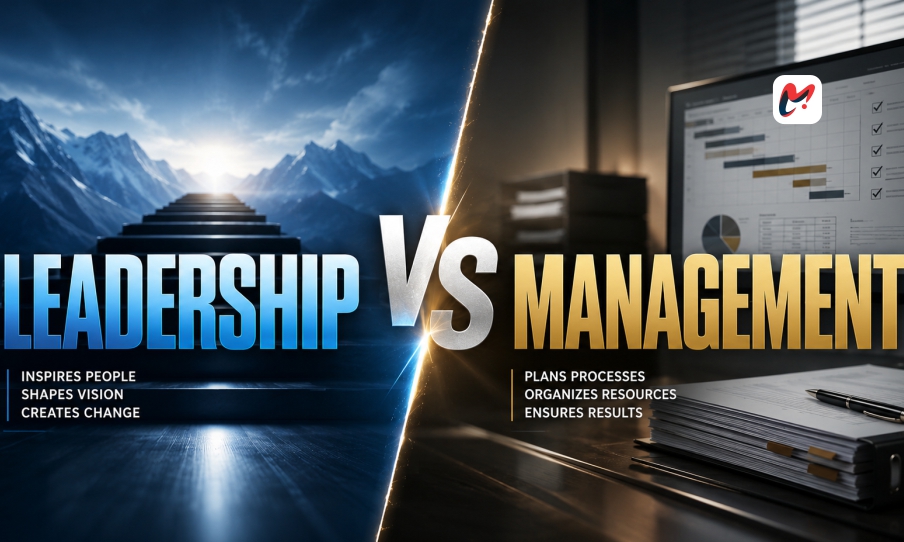
Organizations often treat the terms leadership and management interchangeably, yet these are two distinct concepts. It is crucial to understand the differences between management and leadership to identify the strengths of each area and develop the proper skills. Some people are better at managing – organizing, controlling, and directing others, whereas others are born leaders who can inspire and drive a team towards achieving goals and objectives. The primary challenge in determining the difference between leadership and management is identifying where the end of one begins and the other starts.
It is necessary to explain the difference between management and leadership to facilitate the creation of effective strategies for managing and leading people. The debate on whether management or leadership is more important for an organization has been going on for decades. The reason is quite clear – regardless of the presence of inspiring leaders, managers are essential in executing tasks and getting the exact result. At the same time, the organization will stagnate without charismatic leaders who can bring a new vision and promote change.
Explain the difference between management and leadership
Management and leadership are entirely different concepts that should be treated separately. It is essential to distinguish between management and leadership to comprehend their meaning better. Effective management practices enable the organization to set clear goals, establish efficient processes, and develop long-term objectives. Management activities are often concentrated on making sure everyone knows their responsibilities and works toward the same objective following previously established rules and policies.
On the other hand, leadership is about influencing and driving people toward accomplishing goals and promoting change. Leaders are not born to take care of processes; they strive to achieve objectives while managing various complexities associated with people’s behavior. Leaders play a vital role in any organization as they provide direction and motivation; however, regardless of their ability to inspire, they should not attempt to control people. This is when management practices become essential to ensure everything runs smoothly.
Leadership Focuses on Vision and Inspiration
Leaders create a sense of purpose. They help people understand why their work matters and how it contributes to a larger mission. Instead of simply assigning tasks, they inspire commitment and encourage individuals to perform beyond expectations.
A strong leader is often comfortable with uncertainty. They are willing to challenge traditional methods, explore new opportunities, and take calculated risks. Their influence usually comes from trust, credibility, and the ability to motivate others rather than from formal authority alone.
Leadership also involves emotional intelligence. Effective leaders understand the strengths, concerns, and motivations of the people around them. They build relationships, encourage collaboration, and create an environment where individuals feel valued.
In the discussion of leadership vs management, leadership is frequently associated with transformation. It drives organizations toward new goals and helps teams adapt during periods of change.
Management Ensures Structure and Execution
Management, on the other hand, is deeply connected to planning and organization. Managers establish systems, define responsibilities, allocate resources, and monitor performance. Their primary responsibility is ensuring that work gets completed efficiently and consistently.
A manager often works with timelines, budgets, and measurable outcomes. They develop strategies to reduce risk, improve productivity, and maintain operational stability. While leaders may focus on the future, managers focus on the present and make sure current objectives are achieved.
Good management is especially important in large organizations where coordination is critical. Without effective managers, teams can become disorganized, deadlines may be missed, and resources can be wasted. Management provides the structure that allows employees to work together effectively.
The conversation around leadership vs management sometimes creates an unnecessary competition between the two. In reality, management is not merely administrative work. It is a crucial discipline that turns plans into results.
Why Organizations Need Both
Businesses rarely succeed with leadership alone or management alone. Sustainable success comes from balancing both functions. Leaders create direction and inspire people to move forward, while managers ensure that progress happens in a practical and organized way.
Consider a company launching a new product. Leadership defines the vision, communicates the purpose, and motivates the team to embrace innovation. Management develops schedules, assigns responsibilities, controls budgets, and tracks milestones. Without leadership, the team may lack enthusiasm. Without management, the project may never reach completion.
This balance becomes even more important during periods of growth or uncertainty. Organizations facing rapid change require leaders who can guide people through uncertainty and managers who can maintain operational efficiency at the same time.
Understanding leadership vs management also benefits individuals who want to advance in their careers. Someone in a managerial role can develop leadership qualities such as communication, empathy, and strategic thinking. Likewise, leaders can strengthen their impact by improving planning, organization, and execution skills.
Becoming a Leader and a Manager
The most effective professionals often combine elements of both leadership and management. They know when to inspire and when to organize. They can motivate teams while also ensuring accountability and performance. This combination creates trust, drives productivity, and supports long-term success.
Modern workplaces increasingly value people who can balance these abilities. Employees want leaders who understand their needs, but they also need managers who provide clarity and structure. Organizations that encourage both skill sets often create healthier cultures and stronger results.
Ultimately, the discussion of leadership vs management should not focus on choosing one over the other. Leadership provides vision, direction, and inspiration. Management delivers structure, discipline, and execution. Together, they form the foundation of successful organizations and high-performing teams. Rather than asking which is better, the better question is how to develop the strengths of both.