“Who can ever forget the iconic, Zealous words of Nick Harris?”
For MotoGP fans, that wasn’t just another line from the commentary box. It was a moment of pure admiration from one of the sport’s most respected voices, spoken in the heat of witnessing greatness unfold on the racetrack. Nick Harris had narrated countless races and celebrated champions across generations, yet those words carried a weight that few pieces of sports commentary ever achieve. They captured what millions of fans were thinking every time Valentino Rossi produced another ride that defied expectation, a ride so complete that it demanded respect before celebration.
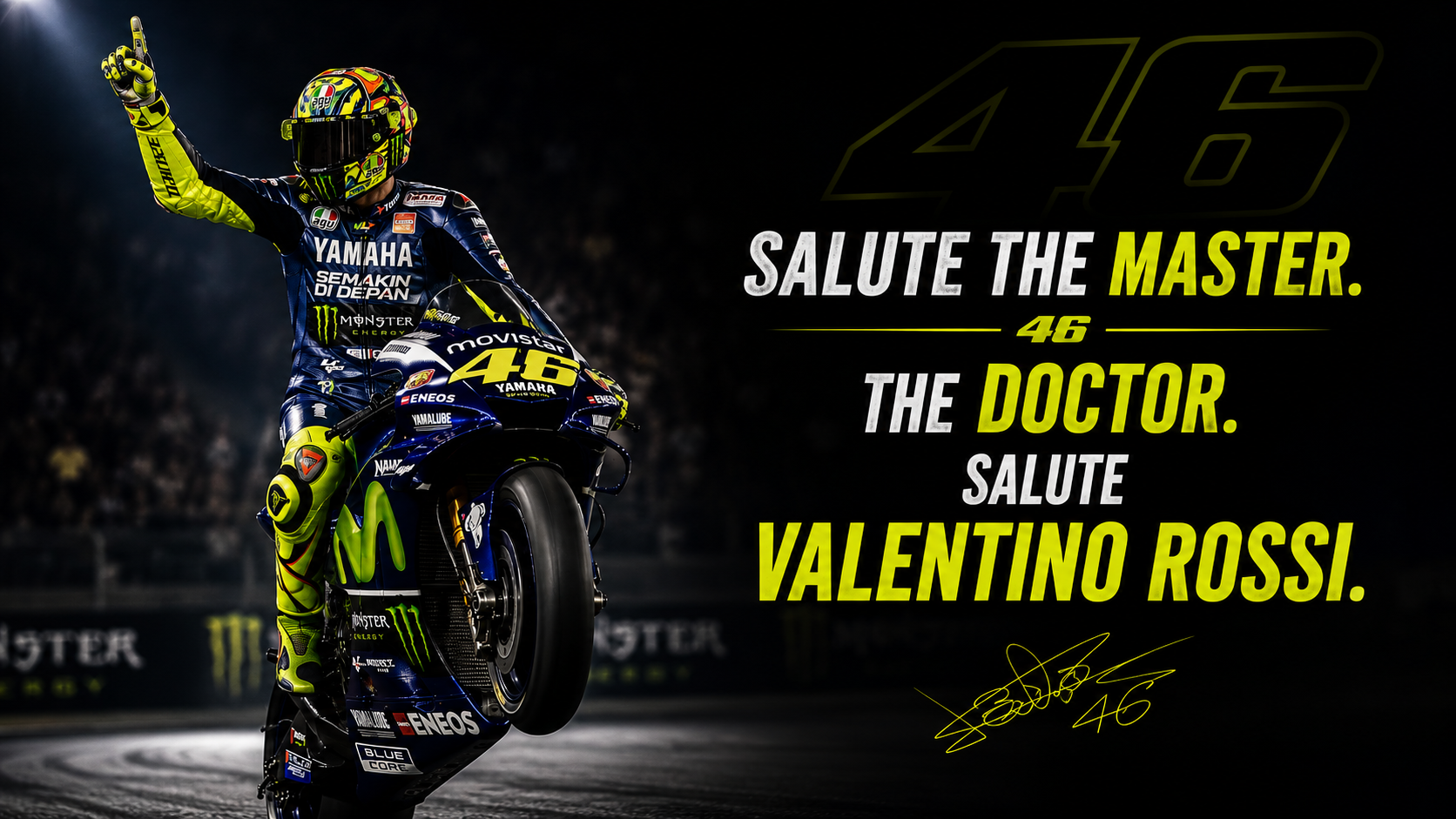
There are champions. There are legends. And then there is Valentino Rossi.
You don’t simply remember watching Valentino Rossi race; you remember where you were when he did something impossible.
Perhaps it was the way he carried impossible lean angles through Mugello’s sweeping corners. Perhaps it was the sight of that unmistakable fluorescent yellow helmet disappearing into Turn 1 before reappearing, somehow, at the front of the pack. Or perhaps it was the smile. That infectious grin behind the visor that reminded everyone that, despite riding a 300-horsepower prototype at over 350 km/h, he was still a man who loved racing more than anything else.
MotoGP has crowned many world champions. It has produced fearless riders, technical geniuses, and breathtaking talents. Yet no rider has connected with generations of fans quite like Valentino Rossi. To millions, he wasn’t merely another competitor chasing championships. He became the heartbeat of the sport.
Long before streaming platforms brought MotoGP into living rooms around the world, fans travelled across continents wearing bright yellow shirts with one number proudly printed across the back: 46. They weren’t supporting a manufacturer. They weren’t supporting a nationality. They were supporting a personality who raced with courage, celebrated with humor, lost with dignity, and never stopped believing that another victory was possible.
That is why, years after his final MotoGP race, conversations about the greatest rider of all time still begin with one name.
Valentino Rossi.
Every Legend Starts Somewhere
Every sporting legend has an origin story, and Valentino Rossi’s began long before packed grandstands echoed with chants of “Vale! Vale!” or millions of fans around the world celebrated another unforgettable Sunday. It began in the quiet Italian town of Tavullia, where motorcycles were never distant machines admired from afar but an inseparable part of everyday life. Racing wasn’t an aspiration introduced later in life; it was woven into the fabric of his childhood, shaped by family, environment, and an almost instinctive attraction to speed.
Much of that influence came from his father, Graziano Rossi, a former Grand Prix motorcycle racer who understood the demands of the sport better than most. Having experienced the exhilaration and sacrifice that accompanied professional racing, Graziano resisted the temptation to mould his son into the rider he himself had been. Instead, he allowed Valentino’s fascination with motorcycles to develop naturally, surrounding him with engines, mechanics, and race weekends without ever turning them into an obligation. The family garage became a classroom where conversations revolved around motorcycles, racing lines, tyre choices, and the countless details that separate good riders from great ones. By the time Valentino was old enough to ride, the language of motorcycle racing already felt as familiar as his native Italian.
His first experiences came aboard minimoto motorcycles, tiny machines that looked more like toys than future championship-winning equipment. Yet these compact bikes became the foundation of everything that followed. Their modest power demanded precision rather than brute force, teaching him balance, throttle control, cornering technique, and racecraft at an age when most children were only beginning to discover organized sport. Every lap refined his instincts, every mistake sharpened his judgement, and every local victory quietly reinforced a belief that he belonged on two wheels.
Interestingly, motorcycles were not always expected to define his future. Concerned about the dangers associated with racing bikes, his mother, Stefania Palma, encouraged him to pursue karting instead. Valentino embraced the challenge with characteristic enthusiasm and quickly proved that his talent extended well beyond motorcycles.
Competing in regional kart championships, he displayed remarkable speed, composure under pressure, and an innate understanding of racing that suggested Formula One could one day become a realistic destination. For a young Valentino, the prospect of building a career on four wheels appeared every bit as exciting as life on two.
Ultimately, however, motorsport is shaped as much by circumstance as by talent. Progressing through competitive karting demanded financial resources that far exceeded what the Rossi family could comfortably invest, while motorcycle racing offered a more practical and accessible pathway. Looking back, that decision stands as one of the sport’s defining turning points.
Had circumstances been different, the world might have witnessed Valentino Rossi battling for Formula One championships rather than rewriting the history of Grand Prix motorcycle racing. Instead, he returned to motorcycles with renewed conviction, setting in motion a journey that would transform not only his own career but also the global popularity of MotoGP.
Learning to Win Before Learning to Dominate
By the early 1990s, Valentino Rossi had outgrown local competitions, and it became increasingly clear that his talent demanded a bigger stage. He entered the Italian Sport Production Championship riding a Cagiva Mito 125, a motorcycle that introduced him to the unforgiving realities of professional racing. Success did not arrive overnight. His debut season was punctuated by crashes, mechanical setbacks, and the steep learning curve that every young rider must endure when competing against seasoned professionals. Yet those who watched Rossi closely noticed something more valuable than victories. He possessed an unusual ability to learn from every mistake, often returning to the circuit after a disappointing weekend with a pace that suggested he had already solved the problems that had troubled him only days before.
That resilience soon attracted the attention of Paolo Pileri, the 1975 125cc World Champion and one of Italy’s most respected talent spotters. Pileri saw beyond Rossi’s raw speed and recognized a rider with exceptional race intelligence. Under his guidance, Valentino refined not only his riding technique but also his understanding of motorcycle development, race strategy, and tyre management, qualities that would later distinguish him from many of his fiercest rivals. The partnership accelerated his progression through the junior categories and prepared him for the leap to the world stage.
When Rossi entered the 125cc World Championship with Aprilia in 1996, he arrived with little fanfare outside Italy. The championship already featured experienced riders who understood every circuit and every nuance of Grand Prix racing. Rossi’s season reflected the unpredictability of a gifted rookie. There were spectacular overtakes, costly crashes, flashes of brilliance, and moments of frustration. Yet amid that inconsistency came a breakthrough that announced his arrival in the racing world. At the Czech Grand Prix in Brno, the young Italian claimed his maiden Grand Prix victory after mastering changing weather conditions and demonstrating composure far beyond his years. It was not merely his first win; it was the moment the paddock realized that a remarkable new talent had arrived.
The following season removed any lingering doubts. Riding the Aprilia RS125, Rossi combined blistering speed with a level of consistency rarely seen from a rider barely out of his teens. He won 11 of the 15 races on the calendar and secured the 1997 125cc World Championship, establishing himself as the sport’s brightest young star. While the statistics were impressive, what captivated fans was the manner in which he raced. Rossi rarely settled for conservative victories. He attacked relentlessly, searched for overtaking opportunities where others saw none, and carried an infectious confidence that made every race feel unpredictable. Even in those early years, the celebrations after each victory hinted at the entertainer he would later become, revealing a personality as vibrant as his riding style.
Championship success naturally brought promotion to the 250cc category in 1998, a class that demanded far greater technical precision and physical strength. The Aprilia RS250 was considerably more demanding than its smaller predecessor, requiring riders to maintain momentum through corners while extracting every ounce of performance from a highly strung two-stroke engine. Many promising riders needed years to adapt. Rossi needed little more than a season. Although he narrowly missed the title in his rookie campaign, collecting five victories and finishing second overall, his performances demonstrated that he was already capable of challenging the very best in the intermediate class.
A year later, he completed what many expected from the outset. The 1999 250cc World Championship became another showcase of Rossi’s growing maturity as a racer. He balanced aggression with patience, attacked when opportunities presented themselves, and avoided the costly mistakes that often separate champions from contenders. By the end of the season, he had claimed the world title with commanding authority, becoming only the latest rider to graduate successfully through Grand Prix racing’s traditional ladder. More importantly, he had convinced the paddock that he was ready for the premier class.
His progression through the junior categories also tells the fascinating story of the Valentino Rossi bike evolution. Every motorcycle he rode represented a different chapter in his development. From the minibikes that first taught him balance and throttle control, to the Cagiva Mito 125 that introduced him to national competition, followed by the championship-winning Aprilia RS125 and the technically demanding Aprilia RS250, each machine expanded his understanding of racing. Rather than relying solely on natural talent, Rossi developed an extraordinary ability to communicate with engineers, identify the strengths and weaknesses of a motorcycle, and adapt his riding style to suit changing machinery. That technical intelligence would later become one of the defining characteristics of his MotoGP career.
By the turn of the millennium, anticipation surrounding Rossi had reached extraordinary levels. The premier class was entering a fascinating period, populated by established champions, factory-backed teams, and riders whose reputations had been built over many years. For Valentino, however, the move represented more than a promotion. It was the opportunity to discover whether the fearless teenager from Tavullia could challenge the finest motorcycle racers in the world.
Few could have imagined that the next chapter would not simply produce another world champion. It would produce a rider who would redefine MotoGP itself, transform the commercial appeal of motorcycle racing, and inspire generations of riders who grew up believing that wearing the number 46 meant believing that anything was possible.
The Arrival of “The Doctor”: A Champion Who Refused to Follow the Script
When Valentino Rossi entered the premier class in 2000, few questioned his talent, but many questioned the timeline. The 500cc World Championship was the pinnacle of motorcycle racing, a category where the sport’s toughest competitors battled aboard violent, two-stroke machines that demanded extraordinary courage and precision. It was a championship that had humbled many gifted riders before him, and conventional wisdom suggested that Rossi would need several seasons to mature before seriously challenging for the title.
Valentino Rossi had other plans.
Riding the Honda NSR500 for the Nastro Azzurro Honda team, Rossi approached his rookie season with the confidence that had become his trademark throughout the junior categories. He did not ride like a newcomer cautiously learning the ropes; instead, he attacked established champions with the same fearless determination that had carried him through the 125cc and 250cc championships. His maiden victory at the British Grand Prix in Donington Park silenced any doubts about whether he belonged among the elite. By the end of the season, he had finished second in the championship behind Kenny Roberts Jr., an extraordinary achievement for a rider experiencing the premier class for the first time.
If 2000 announced his arrival, 2001 confirmed the beginning of an era.
Still aboard the Honda NSR500, Rossi produced one of the most commanding campaigns in recent memory, winning 11 Grands Prix and securing his first premier-class world championship. More significantly, he became the last rider in history to win the 500cc World Championship before MotoGP replaced the category with four-stroke prototypes in 2002. It was a fitting distinction for a rider who seemed destined to bridge two generations of motorcycle racing, mastering the brutal two-stroke era before becoming the defining figure of the modern MotoGP age.
The arrival of the four-stroke Honda RC211V in 2002 transformed the championship, introducing unprecedented levels of power, electronic sophistication, and technical complexity. While many riders struggled to adapt, Rossi appeared almost liberated by the new machinery. His understanding of motorcycle dynamics, coupled with an extraordinary ability to communicate with engineers, allowed him to exploit the RC211V more effectively than anyone else on the grid. The result was one of the most dominant seasons MotoGP had ever witnessed. Rossi claimed 11 victories, stood on the podium in nearly every race, and comfortably retained his world championship.
He repeated the feat in 2003, collecting another title with Honda and reinforcing a growing belief that the championship had become his to lose. Yet despite his extraordinary success, Rossi was becoming increasingly uncomfortable with a narrative that attributed his victories more to Honda’s engineering than to his own brilliance. Critics argued that anyone riding the RC211V would inevitably dominate, diminishing the influence of the rider behind the handlebars.
Rather than ignore the criticism, Rossi made one of the boldest decisions in motorsport history.
At the end of the 2003 season, he walked away from the most successful motorcycle on the grid and signed with Yamaha. This manufacturer had not won a riders’ championship since Wayne Rainey a decade earlier. Many observers described the move as career suicide. Yamaha’s YZR-M1 lacked the consistency, balance, and outright competitiveness of Honda’s prototype, and few believed Rossi could immediately transform its fortunes. Even seasoned analysts predicted that he would spend several years rebuilding before challenging for another title.
Rossi viewed the challenge differently.
He famously remarked that his greatest motivation came from proving that riders, not motorcycles, won championships. It was a statement that carried immense risk because failure would strengthen every criticism leveled against him. Success, however, would elevate him beyond statistics and establish him as a rider capable of reshaping an entire manufacturer’s fortunes.
The answer arrived almost immediately.
In his very first race for Yamaha at Welkom, South Africa, Rossi delivered one of the defining performances of his career. Locked in an intense battle with Honda’s Max Biaggi, he rode with remarkable composure, eventually taking the chequered flag to hand Yamaha its first victory in nearly two years. The emotional celebrations that followed reflected more than another race win; they symbolized the beginning of one of the greatest rider-manufacturer partnerships in motorcycle racing history.
What followed during the 2004 season remains one of MotoGP’s greatest achievements. Rossi did not merely make Yamaha competitive; he transformed it into a championship-winning force. Winning nine races and claiming his fourth consecutive premier-class title, he silenced every critic who believed his previous dominance had depended solely on Honda’s engineering superiority. For many historians, this championship remains one of the finest accomplishments of his career because it demonstrated qualities that statistics alone cannot measure: leadership, technical vision, resilience, and an extraordinary ability to inspire an entire factory to believe in itself.
As discussions around the Valentino Rossi bike continue decades later, this period often occupies centre stage. The transition from Honda’s dominant RC211V to Yamaha’s developing YZR-M1 illustrated why Rossi was regarded as far more than an exceptionally fast rider. He became an integral part of motorcycle development, spending countless hours with engineers, analyzing telemetry, refining chassis balance, and helping transform promising prototypes into championship-winning motorcycles. Riders possess the instinct to ride quickly; legends possess the ability to make the motorcycle itself faster.
By the middle of the decade, Valentino Rossi had advanced into something far greater than a multiple-time world champion. He had become the face of MotoGP, attracting audiences that extended well beyond traditional motorcycle racing fans. Grandstands around the world glowed in fluorescent yellow, television audiences surged, merchandise bearing the famous number 46 sold in extraordinary numbers, and race weekends increasingly revolved around one central question: Could anyone stop Valentino Rossi?
For several years, the answer remained remarkably consistent.
Very few could.
The Peak of Greatness: Races That Defined a Legend and Rivalries That Shaped an Era
Every sporting icon has seasons that fill record books, but only a handful produce moments that become timeless. Valentino Rossi’s greatness was never measured solely by the nine World Championships, 115 Grand Prix victories, or 235 podium finishes. It was measured by the races that people continue to revisit years later, not because they have forgotten the outcome, but because they still marvel at how he made the impossible seem inevitable.
Rossi had an extraordinary gift for understanding the rhythm of a race. While others attacked from the opening lap, he often preferred to study his rivals, almost as if he were collecting information corner by corner. He observed their braking points, noticed where they struggled with tyre wear, and patiently waited for the smallest crack to appear. Then, often in the closing laps when the pressure reached its peak, he would strike with clinical precision. It was this combination of patience, race intelligence, and fearless execution that earned him the nickname “The Doctor.” Contrary to popular belief, the nickname was never about medicine. In Italy, “Doctor” is often used as a mark of respect for someone who performs their craft with exceptional intelligence and precision, and few riders embodied those qualities better than Rossi.
Among his countless victories, several races have become permanent chapters in MotoGP history.
The 2004 South African Grand Prix at Welkom was more than just another race win. It marked Rossi’s debut for Yamaha after leaving the all-conquering Honda team, a move many experts described as the biggest gamble of his career. Yamaha had not won consistently for years, and critics questioned whether even Rossi could reverse its fortunes. Yet, in front of a captivated paddock, he battled Max Biaggi from start to finish before crossing the line victorious. The image of Rossi celebrating beside the Yamaha garage remains one of the defining photographs in modern motorcycle racing because it symbolized that greatness belongs not only to those who choose the easiest path, but also to those willing to embrace the hardest one.
If Welkom proved his courage, Jerez 2005 demonstrated his resilience. The Spanish Grand Prix delivered one of the fiercest duels the sport had witnessed as Rossi and Sete Gibernau exchanged overtakes throughout the race before colliding dramatically on the final lap. Rossi’s controversial move at the final corner secured victory, ignited one of MotoGP’s most talked-about rivalries, and divided opinion across the racing world. Some believed it epitomized hard racing; others felt it crossed the boundaries of fair competition. Regardless of perspective, the incident transformed their relationship forever and reinforced Rossi’s reputation as a rider who refused to surrender even the smallest opportunity.
Then came Catalunya in 2009, a race that many historians, journalists, and former riders continue to regard as the finest MotoGP contest ever staged. The battle between Valentino Rossi and Jorge Lorenzo unfolded over twenty-five laps of relentless intensity, with the two Yamaha teammates exchanging positions repeatedly while pulling away from the rest of the field. Lorenzo appeared destined for victory until Rossi produced one of the most remarkable overtakes in Grand Prix history, diving underneath his teammate at the final corner before accelerating to the chequered flag. It was an overtake born not from desperation but from absolute conviction, executed with millimeter-perfect precision under immense pressure. Even today, discussions about MotoGP’s greatest races almost inevitably return to Barcelona in 2009.
A year earlier, at Laguna Seca in 2008, Rossi had delivered another unforgettable masterclass, this time against Casey Stoner. Their duel reached its defining moment at the famous Corkscrew, where Rossi briefly ran onto the dirt before somehow maintaining control, rejoining the circuit alongside Stoner, and eventually taking the lead. It was an overtake that demanded extraordinary courage because the slightest mistake would almost certainly have ended both riders’ races. Instead, it became one of the most replayed maneuvers in MotoGP history and perfectly illustrated why Rossi’s racecraft was considered unmatched.
Great champions are often defined by their rivals, and Rossi’s career unfolded against some of the finest motorcycle racers the sport has ever produced.
His earliest and perhaps most emotionally charged rivalry came with Max Biaggi, another proud Italian whose success had already established him as one of the championship’s leading figures before Rossi arrived in the premier class. Their relationship was never cordial. Press conferences frequently carried an unmistakable tension, and every on-track battle became a contest for national pride as much as championship points. Their contrasting personalities, Biaggi’s composed confidence against Rossi’s playful unpredictability, captivated fans and elevated MotoGP’s popularity during the early 2000s.
The rivalry with Sete Gibernau emerged during Rossi’s Yamaha years and reached its dramatic climax at Jerez in 2005. Before that controversial final-corner collision, the two shared mutual respect and often fought wheel-to-wheel without incident. Afterward, their relationship deteriorated rapidly, giving MotoGP one of its most intense personal rivalries. Whether viewed as ruthless determination or uncompromising ambition, Rossi’s refusal to yield became one of the defining characteristics of his competitive spirit.
Perhaps the purest contest of riding ability came against Casey Stoner. The Australians’ extraordinary control over Ducati’s notoriously demanding Desmosedici contrasted sharply with Rossi’s smooth, calculated style. Stoner relied on breathtaking speed and instinct, while Rossi combined technical intelligence with relentless psychological pressure. Their battles, particularly during the 2007 and 2008 seasons, showcased two entirely different philosophies of motorcycle racing, each pushing the other to remarkable levels of performance.
No rivalry, however, evolved as dramatically as the one with Jorge Lorenzo. Initially united as Yamaha teammates, the relationship quickly became one of mutual respect, overshadowed by fierce competition. Sharing the same garage while competing for the same championship created an atmosphere unlike any other in MotoGP. Communication between their respective crews became increasingly restricted, and the famous wall separating their garages symbolized just how intense the rivalry had become. Yet it also produced some of the highest-quality racing the championship has ever witnessed, with both riders forcing each other to redefine excellence continually.
The final major chapter of Rossi’s competitive journey unfolded against Marc Márquez, a rider nearly fourteen years his junior who represented the arrival of a new generation. Their relationship began with admiration but gradually descended into one of the most controversial rivalries in motorcycle racing history, culminating in the dramatic events of the 2015 season. The disputes surrounding Sepang, Phillip Island, and Valencia remain among the most debated episodes in MotoGP, dividing fans and experts alike. Regardless of differing opinions, the controversy highlighted Rossi’s enduring competitiveness. Even at thirty-six years of age, he remained capable of challenging riders entering the peak of their physical careers.
Not every chapter, however, reflected triumph. Every legendary career contains periods of adversity, and for Rossi, the most difficult arrived during his return to Ducati between 2011 and 2012. The move carried enormous expectations, promising to unite Italy’s greatest rider with its most celebrated motorcycle manufacturer. Instead, it became one of the biggest disappointments of his career. The Ducati Desmosedici proved exceptionally difficult to adapt to, and despite countless development efforts, Rossi managed only three podium finishes across two seasons without securing a single victory. His 2012 campaign, in particular, is widely regarded as the lowest point of his MotoGP career, not because it diminished his talent, but because it reminded the sporting world that even the greatest champions cannot overcome every technical limitation.
Yet perhaps that difficult chapter revealed more about Valentino Rossi than any championship ever could. Rather than searching for excuses or allowing disappointment to define him, he returned to Yamaha in 2013 with renewed determination, proving that resilience, not perfection, had always been the true foundation of his greatness.
The Helmet That Became an Identity, the Bikes That Built a Legacy, and the Fortune of a Global Icon
There are riders whose helmets are remembered because they won championships, and then there is Valentino Rossi, whose helmet became an extension of his personality. Long before personalized liveries became commonplace in MotoGP, Rossi transformed his helmet into a canvas that told stories, reflected emotions, celebrated milestones, and connected with millions of fans around the world. For many enthusiasts searching for the Valentino Rossi helmet, it is not merely a piece of racing equipment but one of the most recognizable symbols in motorsport history.
At the heart of that identity lies the iconic Sun and Moon design, a motif that first appeared in the late 1990s and accompanied Rossi throughout most of his professional career. Created alongside renowned helmet designer Aldo Drudi, the artwork represented the duality of Rossi’s personality. The radiant sun symbolized the energetic, extroverted entertainer who celebrated victories with theatrical flair. At the same time, the moon reflected the calm, thoughtful competitor who spent countless hours analyzing telemetry, understanding tyres, and preparing meticulously for every race weekend. Together, the two elements perfectly captured a rider who balanced exuberance with extraordinary discipline.
Over the years, the Valentino Rossi helmet evolved into far more than its famous sun and moon graphics. Rossi frequently introduced special-edition designs to commemorate significant milestones, honor personal relationships, or inject humor into the sport.
At Mugello, his home Grand Prix, fans eagerly anticipated what surprise would emerge each season. Some helmets paid tribute to Italian culture, while others featured playful caricatures, animated artwork, or references to memorable moments from his career.
Following the passing of his close friend and fellow rider Marco Simoncelli in 2011, Rossi carried heartfelt tributes on his helmet, ensuring that every lap also honored a friendship that had extended far beyond the racetrack. His farewell MotoGP season in 2021 featured commemorative graphics celebrating more than two decades in Grand Prix racing, transforming the helmet into a visual timeline of an extraordinary career.
Just as iconic as his helmet was the remarkable journey of the Valentino Rossi bike, a story that mirrors his evolution from an enthusiastic child in Tavullia to one of the greatest motorcycle racers in history. Every machine he rode represented a different stage of learning, challenge, and triumph, contributing to a legacy that few athletes in any sport can rival.
Rossi’s earliest experiences came aboard motocross motorcycles, where he developed the balance, throttle control, and racing instincts that would define his riding style. His competitive education continued on the Cagiva Mito 125 during the Italian Sport Production Championship before progressing to the Aprilia RS125, the motorcycle that carried him to the 1997 125cc World Championship. Promotion to the Aprilia RS250 followed, culminating in the 1999 250cc title and confirming that Rossi had mastered every step of Grand Prix racing’s traditional pathway.
The move to the premier class introduced an entirely new generation of motorcycles. Rossi began with Honda’s legendary NSR500, becoming the final rider to claim the historic 500cc World Championship in 2001 before MotoGP adopted four-stroke machinery. He then rode the revolutionary Honda RC211V, a motorcycle widely regarded as one of the greatest racing prototypes ever built, collecting consecutive MotoGP titles in 2002 and 2003.
His most celebrated partnership, however, came aboard the Yamaha YZR-M1. When Rossi left Honda at the end of 2003, many believed he had sacrificed championship ambitions by joining a manufacturer that had struggled for consistency. Instead, he transformed the M1 into one of the most successful motorcycles in MotoGP history, securing world championships in 2004, 2005, 2008, and 2009 while fundamentally changing perceptions of what a rider could contribute to motorcycle development. Engineers consistently praised Rossi’s technical feedback, often describing his ability to identify subtle handling characteristics that helped accelerate the evolution of the Yamaha project.
In 2011, Rossi accepted perhaps the greatest technical challenge of his career by joining Ducati and racing the Desmosedici GP11 and GP12. The partnership carried immense emotional significance, uniting Italy’s greatest rider with its most celebrated manufacturer, but it ultimately failed to deliver the success both had envisioned. The Ducati’s unique chassis philosophy proved incompatible with Rossi’s riding style, and despite relentless development work, victories remained elusive. Although the experience represented the most difficult chapter of his MotoGP career, it also reinforced his reputation as a rider willing to embrace formidable challenges rather than pursue only comfortable opportunities.
Returning to Yamaha in 2013 restored Rossi’s competitiveness, and successive generations of the YZR-M1 once again allowed him to fight for victories and championships. Even as younger rivals emerged, he continued adding podium finishes, race wins, and unforgettable performances, demonstrating that experience and racecraft could still challenge raw youth and aggression. His final MotoGP race in 2021 marked the conclusion of a remarkable journey spanning more than a quarter of a century, but it did not signal retirement from motorsport. Instead, Rossi redirected his competitive ambitions toward endurance racing, joining Team WRT in GT competition and competing in the GT World Challenge Europe, the FIA World Endurance Championship, and prestigious events including the 24 Hours of Le Mans and the 24 Hours of Spa, proving that the desire to compete remained as strong as ever.
Greatness on the racetrack naturally translated into remarkable commercial success away from it. Discussions surrounding Valentino Rossi net worth continue to attract global interest because his influence extends far beyond race winnings alone. As of 2026, Valentino Rossi net worth is widely estimated to be between $200 million and $250 million, placing him among the wealthiest motorcycle racers in history. While precise figures remain private, the estimate reflects decades of factory contracts, race bonuses, sponsorship agreements, merchandising, licensing, and entrepreneurial ventures.
Rossi’s commercial appeal reached well beyond MotoGP. Long-term partnerships with globally recognized brands, combined with merchandise centered around the iconic number 46, generated substantial revenue throughout his career. His business interests expanded significantly with the creation of the VR46 Riders Academy, an initiative dedicated to developing Italy’s next generation of motorcycle racers. The academy has already produced multiple MotoGP competitors, reinforcing Rossi’s influence on the sport long after his own championship-winning years.
His entrepreneurial ambitions also materialized through the Pertamina Enduro VR46 Racing Team, which competes in MotoGP and serves as a pathway for emerging talent. Combined with the VR46 Store, licensing agreements, apparel collections, and numerous commercial partnerships, these ventures have ensured that the Valentino Rossi brand remains one of the most valuable in global motorsport. Consequently, the Valentino Rossi net worth represents far more than accumulated prize money; it reflects a carefully built legacy that combines sporting excellence with enduring commercial vision.
Today, nearly three decades after his first Grand Prix victory, Valentino Rossi’s influence can still be seen in every MotoGP paddock. Riders who once stood in grandstands wearing fluorescent yellow shirts now compete at the highest level, openly acknowledging him as their inspiration. Manufacturers continue to value rider feedback with a level of sophistication that Rossi helped pioneer. At the same time, fans still gather at circuits around the world wearing the famous 46, celebrating not merely a champion but an era that transformed motorcycle racing into a truly global spectacle.
Statistics alone will always tell an impressive story: nine World Championships, 115 Grand Prix victories, 235 podium finishes, and a career spanning four decades of competitive racing. Yet numbers have never fully explained why Valentino Rossi remains one of the most beloved athletes in motorsport history. His greatest achievement was not simply winning races or championships. It was making millions of people fall in love with motorcycle racing itself.
That is why, whenever conversations turn to the greatest riders the sport has ever produced, one name continues to echo above the rest.