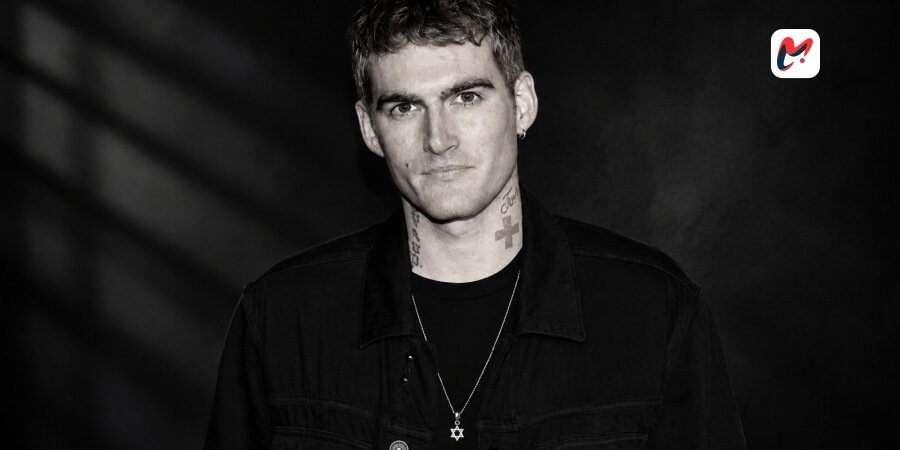
Presley Gerber entered fashion with a surname the industry already knew. As the son of supermodel Cindy Crawford and businessman Rande Gerber, expectations were naturally high when he stepped onto a runway as a teenager. Yet his early career developed quickly enough to show that his appeal was not limited to family recognition. Within weeks of his runway debut, he had appeared in major international fashion shows and secured a Calvin Klein campaign, establishing himself as one of the young male faces attracting attention from luxury brands.
Gerber’s modeling career began at a remarkably young age. He made his runway debut for Moschino’s Los Angeles Resort show in June 2016, when he was 16, walking alongside established models including Miranda Kerr and Jourdan Dunn. Vogue’s coverage at the time noted that he had already gained experience in front of the camera through editorial shoots, including work with photographers such as Mario Testino, Collier Schorr and Bruce Weber.
A Runway Debut That Moved Quickly
Presley Gerber did not spend years waiting for his first major fashion opportunity. His Moschino appearance was quickly followed by an international runway appearance for Dolce & Gabbana during Milan Men’s Fashion Week. The transition from Los Angeles to Milan was significant because it placed him within the traditional fashion-week system, where models are assessed not only on appearance but also on their ability to carry different designers’ visual identities.
His early momentum was unusually visible. W Magazine reported in July 2016 that, within weeks, Gerber had made his Moschino debut, walked for Dolce & Gabbana in Milan and landed a Calvin Klein campaign. That sequence gave him an introduction to three very different sides of the business: runway presentation, European luxury fashion and major commercial advertising.
The Dolce & Gabbana appearance also showed how the fashion industry was changing its approach to young celebrity-connected models. The brand’s Spring/Summer 2017 men’s presentation featured several children of famous entertainers and personalities. Gerber was part of that wider group, but his presence on the runway gave him an opportunity to establish a visual identity separate from his mother’s.
Learning From Cindy Crawford Without Simply Repeating Her
Being Cindy Crawford’s son inevitably influenced how audiences viewed Presley Gerber. His connection to one of fashion’s most recognizable supermodels meant that photographers, designers and editors already understood the family name. But Crawford’s own advice to her children was less about reproducing her career than about approaching the profession with preparation and professionalism.
That distinction became important as Gerber developed. Vogue’s 2016 interview showed that he was interested in photography as well as modeling, describing an appreciation for noticing ordinary moments that other people might overlook. His interest in taking photographs with his sister, Kaia Gerber, suggested that he was comfortable thinking about images from both sides of the camera.
His family connection also gave him an unusual perspective on the industry. He had grown up around fashion, but he reportedly did not initially plan to pursue modeling seriously. That changed after he began working professionally and discovered that he enjoyed the environment more than he had expected.
Major Campaigns Expanded His Profile
Runway appearances can establish credibility, but campaigns often give models a different kind of visibility. A fashion show disappears after the collection is presented, while a major advertising campaign can place a model’s face across magazines, stores, websites and social media.
Presley Gerber’s early campaign work included Calvin Klein, one of the most recognizable names in fashion advertising. He also appeared in Dolce & Gabbana’s Spring/Summer 2017 #DGMillennials campaign, alongside other young figures with famous family backgrounds, including Gabriel-Kane Day-Lewis, Brandon Thomas Lee and Rafferty Law.
The campaign reflected a particular moment in fashion, when established luxury brands were increasingly interested in younger personalities with built-in cultural recognition. Gerber fit naturally into that strategy, but his continued work across different fashion houses helped move his career beyond a single celebrity-family narrative.
He was subsequently associated with brands including Tommy Hilfiger, Balmain and Burberry, while his broader modeling résumé included editorial work for publications such as Vogue Paris, CR Fashion Book and GQ Style.
The Importance of Male Modeling in a Family of Fashion Icons
The career of Presley Gerber also offered an interesting contrast within his own family. Cindy Crawford had been one of the defining female models of her generation, while his younger sister Kaia developed rapidly into a major fashion figure in her own right. Gerber’s career followed a different route, with men’s fashion providing the framework for his runway and campaign work.
That distinction gave him room to develop an identity suited to menswear. His early Dolce & Gabbana work, for example, positioned him within a generation of young male models who were not necessarily traditional fashion-school discoveries. Brands were increasingly interested in personalities who could connect runway fashion with entertainment, social media and popular culture.
His look also worked across different visual environments. The relaxed California image that suited his early Moschino appearance could translate into luxury campaigns, editorial photography and commercial advertising. That adaptability is one of the qualities that can turn an interesting debut into a sustainable modeling career.
A Career That Left Its Mark on Fashion
Presley Gerber’s story in fashion ultimately reflects more than the advantages of growing up around the industry. His entry was unusually fast, but the sequence of opportunities that followed gave him experience across several important parts of modeling. Moschino introduced him to the runway. Dolce & Gabbana brought him into the international men’s fashion circuit. Calvin Klein demonstrated his potential in major advertising, while editorial work gave him another platform for developing his image.
His career also unfolded alongside that of Kaia, creating a new chapter in the Crawford family’s relationship with fashion. Both siblings inherited an unusual connection to the industry, but each developed a distinct professional identity.
Presley Gerber’s modeling career therefore deserves to be viewed as more than a celebrity offspring story. He entered an industry that already knew his family name, but he quickly moved through runways, campaigns and editorial work of his own. His early years showed how a new generation of models could combine fashion heritage, contemporary celebrity culture and personal interests to create a different kind of career. The runway may have been where Presley Gerber first attracted attention, but the breadth of his work across fashion demonstrated why that first appearance became the beginning of a much larger professional story.